Dual Story Arcs in Romantasy: Weaving Fantasy and Romance Together
Romantasy novels weave fantasy and romance arcs together. Learn how dual story arcs interact and how to structure both across your novel.
Landora Shull
3/22/20266 min read


Romantasy writers are Jills of all trades.
(Or Jacks. I see you, male romantasy writers)
We build castles, grow plots, and we weave arcs.
Any good crafter knows that you have to understand the materials you’re working with before starting a project. So let’s talk about arcs.
What’s that, you ask?
The arc is the progression of your plot and characters. The basic spine of a story. It includes things like rising action, climax, and falling action.
No, I couldn’t be any more vague. The problem with the term “arc” is that it's tossed around in writing circles like crafters use the word “glue”. Just glue it = Just build your arc
They leave you wondering: Okay, what kind of glue? Where should I glue it? How should I glue it?
The answer is always the same - It depends on what you’re doing.
But never fear, my magic weaver, I won’t leave you with a shrug and a sigh when it comes to arcs.
When someone says an arc, they often mean this:
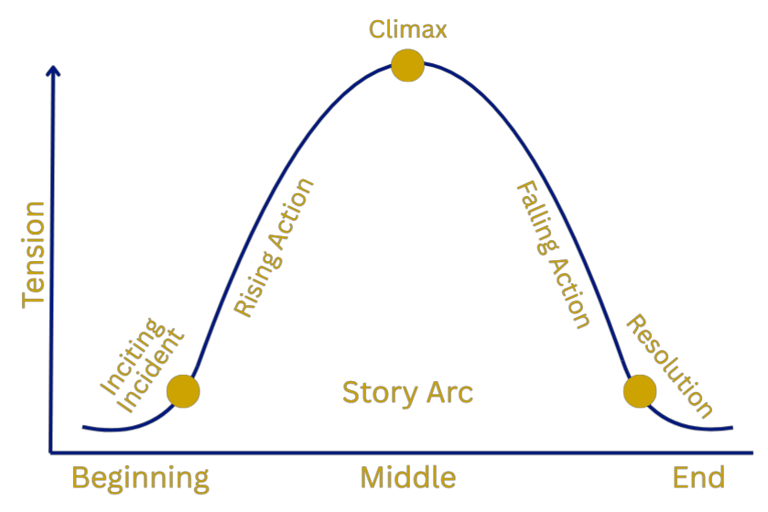
This is a traditional story arc which shows rising conflict leading toward resolution.
Or they might mean a character arc that looks like this:
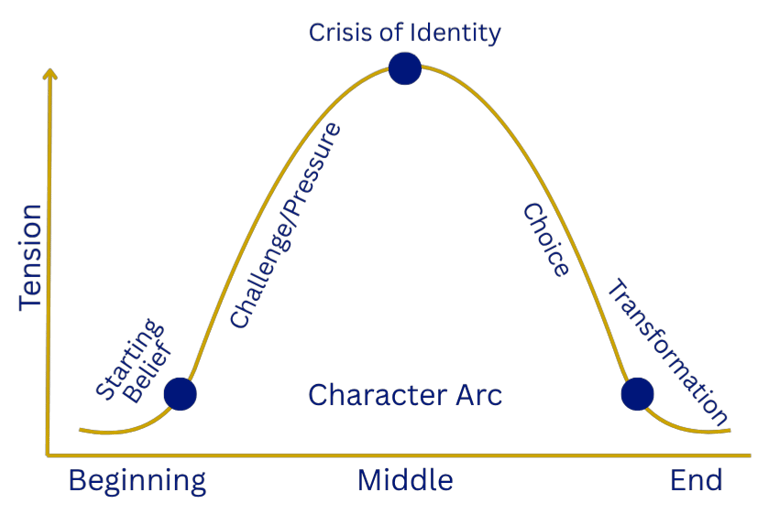
This arc represents emotional transformation rather than external action.
When these arcs begin interacting, they look something like my own current draft:
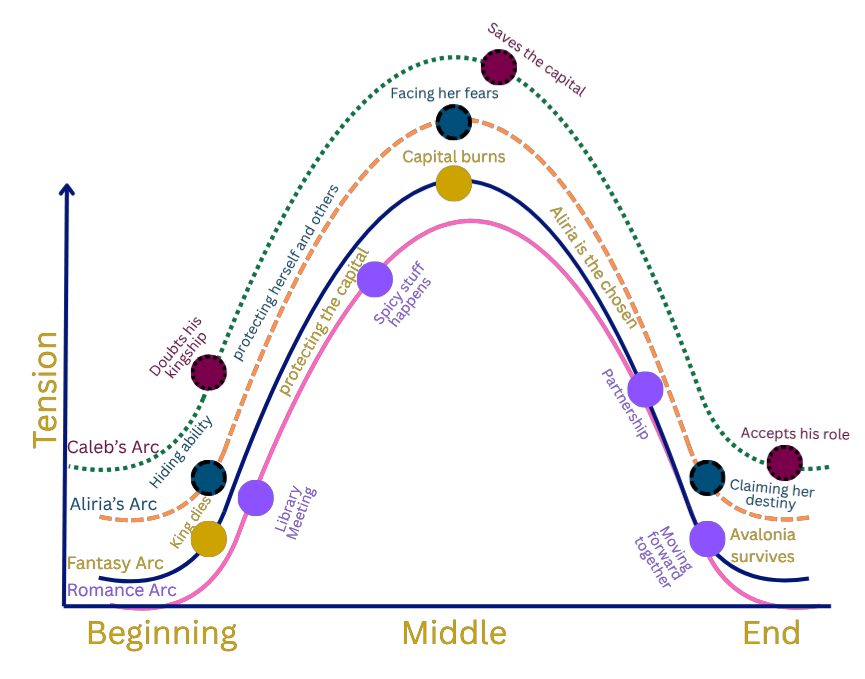
As you can see, the concept of an arc can be applied to several parts of your story.
A plot arc charts external events that rise and fall. A character arc outlines the progression of their internal journey. The points show where we start and the building of tension to a climax. Then the tension falls and we resolve our conflict.
But notice the bottom line.
Just like we discussed in the beginner’s guide, arcs have a beginning, middle and end.
Whether you're overthrowing a tyrant with magical powers or have a morally-gray man falling for the princess next door – you must start at a beginning (we’ll talk about this later), have it change in the middle and give it an end.
Romantasy happens when both fantasy and romance arcs are woven so tightly that the reader can’t tell which one is driving the story.
My current draft is typical of romantasy novels. I have Dual POVs (two main characters) and not one, but two plot arcs. The weaving of those arcs is what makes us crafty masters of our genre.
And I’m about to show you how to DIY it.
Balancing Dual Arcs in Romantasy
We don’t usually intend to weave a lopsided basket. It happens though. Stories are told on a spectrum between fantasy-driven plots and romance-driven plots. Sometimes the fantasy arc overtakes the romance or vice versa.
For the sake of this article though, we’re looking for a balance of the two.
The key word being balance and not parallel.
Notice how the dots on my arcs don’t line up exactly. All of them happen—but not in the same place at the same time. A good weaver knows that straight lines are boring. Variety is what gives your work personality. In story form that usually means letting the arcs fit together at their own pace.
So how do you do that? With practice and some tips from me.
Here are three ways to balance arcs across your novel.
Step One: Identify Each Arc
You can’t weave invisible threads. Examine your fantasy, romance, and character arcs.
Where do they start? What changes inside them? Where do they end?
If you plot the points on the arc as I did in my current draft, now you have your pattern. You know what to weave.
Step Two: Build bridges
Look for places inside your beginning, middle and end where these arcs can connect. The trick is to guarantee that no arc can get to the next point without using a bridge.
You’ll notice on my diagram that not every section is labeled or in the same place. These gaps are where another arc has bridged the story. Let’s talk about the beginning of my current draft as an example.
Caleb spends at least half of the novel wondering if he can be a good king (character arc). While he’s doing that, Aliria is helping him protect the capital (fantasy arc). She intended to point out the problem and leave, but she’s interested in him (romance arc). So she stays while wrangling her trauma and unsteady ability (character arc).
Every piece weaves into the others in some way. None of them can stand on their own. They have to cross a bridge in order to get to the next step.
Step Three - Hit those beats
A great way to make sure your arcs are woven is to hit both fantasy and romance beats.
Have an inciting incident that kicks off your fantasy arc. A romance connection that becomes the catalyst for your story. Create a midpoint sequence that touches both arcs back to back. An organized beat structure is a part of our pattern.
We can use it to balance our arcs and set the pace of our novel.
A warning about arcs and beats. I know the arc diagram says the middle and has the climax at the top but it means the middle of the arc – NOT the middle of your novel. The standard diagram is sneaky and will lead you to believe the climax is the midpoint on the beat sheet. It is not! The climax and resolution usually happen in the third act or the finale. Think of the climax as the big battle or the confession of love. The midpoint should change your story, not end it. The climax is the point that brings resolution of that particular arc.
My modified beat sheet can help you understand these beats and how they apply to weaving dual arcs.
Now it’s your turn.
Try summarizing each stage of your own arcs in a single sentence like the example below. You’re not outlining the whole story—you’re identifying how the arc moves from beginning to end. If you do this for fantasy, romance and at least one character, you’ll have the spine of your story.
Example: The fantasy arc of my own story
Beginning - Inciting Incident
Aliria is requested by the king to help solve his problems in the capital.
Rising Action
Aliria both helps and complicates Caleb’s efforts to stabilize his country with her usual wit and attitude.
Midpoint (not the climax, but when your story changes midway)
The palace is attacked by the villain who tells everyone that Aliria is the Chosen.
Climax
Aliria being named the chosen brings outside enemies and the masses of Avalonia to the capital.
Falling Action
Caleb regains control and the villains are defeated.
End - Resolution
Avalonia is safe with two rulers and an unclear but determined path forward.
Keep going with this template:
Beginning - Inciting Incident
Rising Action
Midpoint (not the climax, but when your story changes midway)
Climax
Falling Action
End - Resolution
At this point, you should begin to see how your arcs weave together. Some of them naturally overlap. But if anything feels like a loose thread, try this exercise:
Play the “what if” game.
What if you removed an arc? Could your fantasy arc survive without the romance or vice versa? Could your characters succeed on their own?
If that’s the case, you have loose threads and it might be time to revisit some pieces of your arc. Sometimes the smallest tweaks can create a bridge you hadn’t thought of yet.
I know this can look complicated on the page, but let me take some of the pressure off.
You already understand story arcs.
They’re part of the way we experience stories as readers. We recognize the rise and fall of tension because other writers have shown it to us again and again. Learning to see your arcs more clearly isn’t about forcing your story into a rigid pattern. It’s about giving your instincts something to work with. Every good weaver follows the shape of the thread in their hands.
So trust your gut—and go weave some arcs.